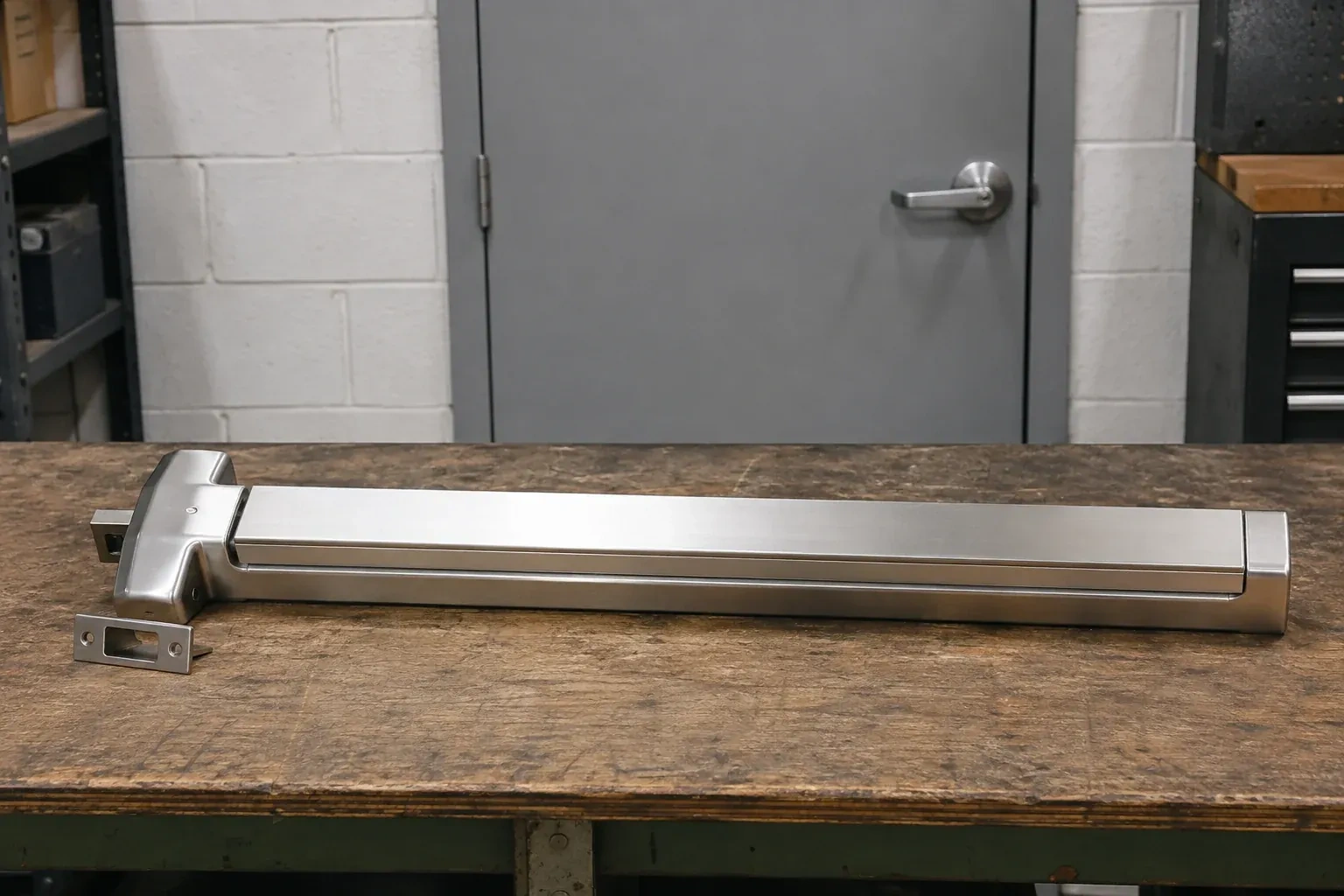
Commercial · Toronto
Panic & Exit Hardware
The fire inspector's note is blunt: the banquet hall's second exit still turns on a deadbolt, and the crowd it is rated to hold needs a door that opens under one motion, no key involved.
Panic & Exit Hardware
In plain words
A code trigger usually starts the conversation: an occupant load over a threshold, a fire inspector's note, or a new use for a room that used to hold far fewer people. From there the visit works out which openings are affected, what device and trim suit each one, and whether a pair of doors needs a coordinator or a mullion removed. The installation follows a template, and every device is tested for release force and full latch engagement before the visit ends, with a written record of what went on the door for anyone reviewing the space afterward.
How the visit goesAfter the fit-out, the gym floor now holds more people than the old office space ever did, and the exit door at the back still has the same turn-lock it had when the room held desks.
Toronto
How the visit goes
Reading the door itself
Every opening gets the same close look: whether it is fire-rated, which way it swings, how wide it is, and what preparation, if any, already exists in the door and frame from earlier hardware. A hollow-metal fire door takes a different device than a wood door in a non-rated partition, and a narrow-stile aluminum storefront door narrows the choice of device further still. Reading this correctly before anything is ordered is what keeps the installation from turning into a second visit once the wrong device arrives and does not fit the preparation already in the door.
Handling a pair of doors
On a pair, a coordinator is fitted only where the hardware needs the leaves to close in a set order, letting the active leaf's device seat into the strike or into an astragal carried on the inactive leaf; many pairs latch independently and skip this step entirely. Where the plan calls for one wide exit instead of two narrow ones, the centre mullion is removed and vertical-rod devices are fitted to each leaf instead, arranged so both close and latch reliably. Either way, both leaves are tested together, not only on their own, before the visit is called finished.
A door that opens under one motion, every time
What the space has afterward is straightforward: anyone inside can leave through that door with a single push on the crossbar or touchpad, no key, no second step, no need to remember which way a lock turns. Staff can be shown the motion once and it stays intuitive, because that is exactly what the hardware is built to do. Outside, entry still works the way it was set up to, through the trim chosen for that door, entirely separate from the exit function inside.
Panic & Exit Hardware
In the van
- Strike and reinforcement
- Signage and labels
- Dogging key or keyed cylinder
- Outside trim (pull, lever or cylinder)
- Astragal and mullion hardware
What affects the quote
Same fees day, night or weekend
1Removing hardware that should not remain
A padlock, hasp or extra deadbolt found on the door is removed and the resulting holes are filled or covered as part of the same visit, which is its own small task in the quote.
2Condition of the existing hardware
A device that only needs adjustment, cleaning and new fasteners costs less in labour than removing a seized or badly worn device and fitting a replacement in its place.
3Occupancy and code documentation needed
A project with a fire inspector's note or a building official's requirement attached usually needs a more detailed written record than a straightforward upgrade an owner requests on their own initiative.
Panic & Exit Hardware: questions
How is panic hardware different from fire exit hardware?
Panic hardware and fire exit hardware share the same push-to-release action, but fire exit hardware is additionally tested and listed for use on a fire-rated door assembly. That extra listing matters because a fire door has to keep an active latch bolt at all times; it cannot carry a mechanical dogging function the way ordinary panic hardware sometimes can, so the two are not interchangeable on a rated opening.
Can I still lock the door from outside?
Yes. The releasing device only governs the inside of the door; the outside gets its own trim, a pull, a lever with a cylinder, or a keyed cylinder alone, chosen for how that door is entered. Locking or unlocking that outside trim has no effect on the inside crossbar, which always releases the latch under a push, so entry security and exit function are handled as two separate questions.
How is occupant load actually counted for this decision?
Occupant load is calculated from the floor area and the intended use of the room, using published factors for that occupancy type, rather than a headcount taken on a busy night. A building official or a locksmith familiar with the calculation can work through it for a specific room, and the result is what decides whether the exit doors serving that room need a releasing device.
Commercial Locks
- Master Key System DesignThe new wing was built with its own brand of cylinder, so the two-year-old keys from the original…
- Access Control InstallationThe back door of the shop runs on one key, and by now it lives on six different rings: yours, two…
- Commercial-Grade Lock ReplacementA new tenant moved into the unit next door, and the property manager just found three different…
Panic & Exit Hardware near you
For a household in Toronto the common requests are a rekey after moving in, a lockout, a deadbolt that grinds, and a lock that finally needs replacing. For a business they are storefront hardware, staff key control and exit devices. Both lists, and a few less common jobs, are laid out here.