Car keys · Toronto
Car Key Replacement
The key snapped at the head while you were turning it in a stiff, frosty door lock. Half the blade is in your hand, the rest is inside the lock, and the plastic head still lights up when you press a button.
Car Key Replacement
In plain words
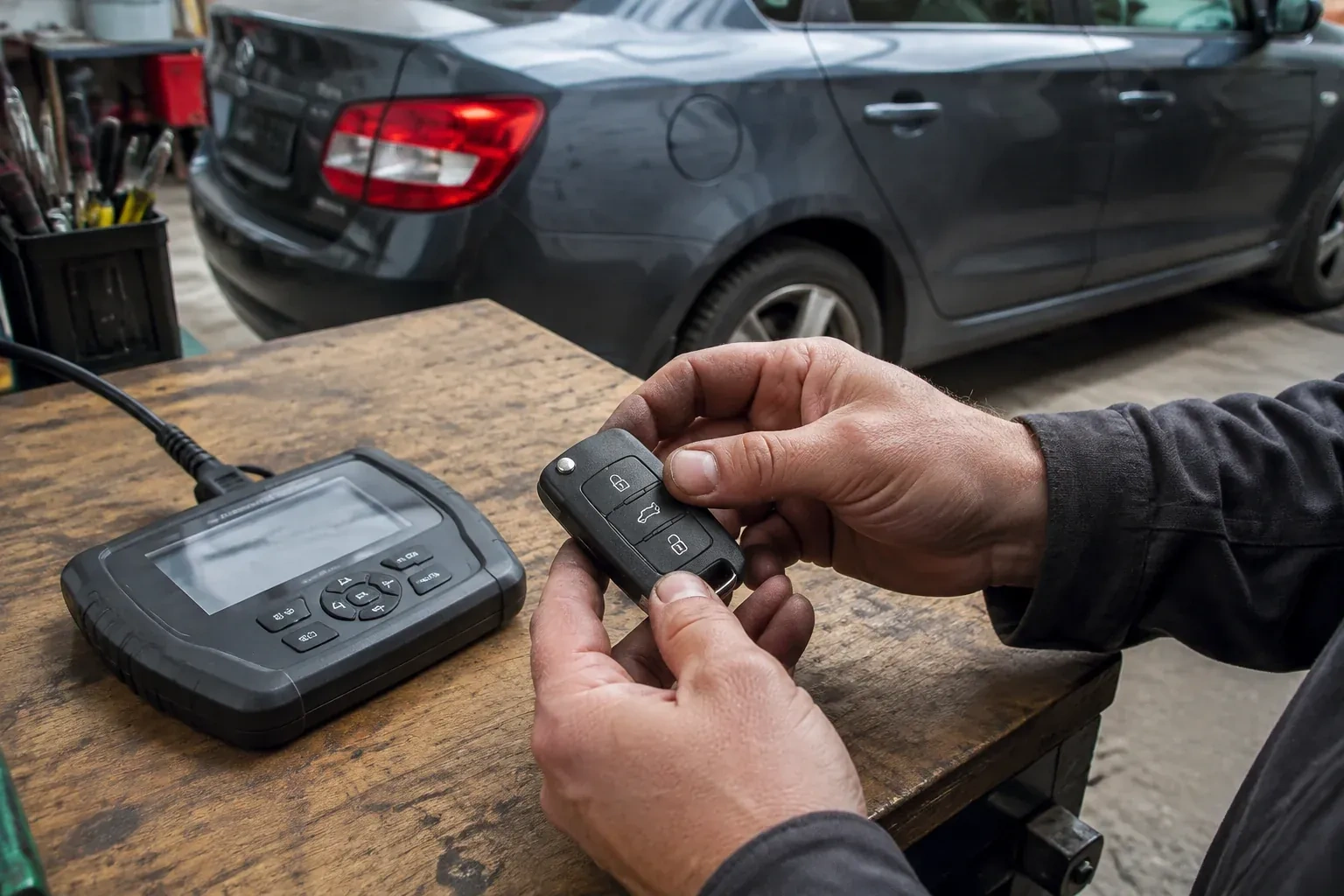
Most replacement keys are made where the car is parked. A mobile locksmith carries blanks, a cutting machine and programming equipment in the van, plugs into the diagnostic port and does the work on your driveway, in a parking garage or at the roadside. For most vehicles there is no need to move the car to a shop, and you watch the key cut and tested on the spot; a few systems still need a dealer or an equipped shop, flagged by the VIN check. The locksmith needs the vehicle's identity, proof of ownership, and what the old key could do, so the right parts are on board.
How the visit goesThe only key to the car went into the lake with the kayak. Now the car sits locked in the driveway with a full tank, and there is no spare in the house, in a coat pocket or anywhere else.
Toronto
How the visit goes
Do you still have one key that works?
The most important fact after ownership is whether a single working key exists. With one in hand, the visit is an add-a-key: the existing key proves the immobilizer is healthy, the new blade can be checked against it, and programming is usually the shorter routine. With none, it is an all-keys-lost job: the blade has to come from the lock or the code, and the immobilizer has to be reset before new keys are stored. A key that opens the doors but no longer starts the engine counts as no working key for programming purposes, though its blade is still useful as a pattern.
Pairing the remote and the proximity fob
The buttons on a key and the transponder in it are usually separate systems, and the remote is paired in its own step. Depending on the vehicle, that is an on-board routine of ignition cycles and button presses, or a command sent through the programming tool. A proximity fob is registered so the car detects it near the door handles and inside the cabin, and push-button start is tested with the fob in a pocket, then held against the start button as the backup method. Remote start, trunk release and panic are checked one at a time, since a wrong part number can pass every step except the one you use most.
Fob batteries through the cold months
A replacement fob leaves with a fresh coin cell, and a small habit keeps it that way. Most vehicles show a low-battery message on the dash weeks before the fob goes quiet; treat it as a to-do rather than an alarm. Cold reduces what a coin cell can deliver, so a battery that is fine in autumn can fail on a January morning. The locksmith shows you how the car starts when a fob is flat, usually by holding it against the start button or in a marked pocket, and where the emergency blade is released, so a dead battery is an errand rather than a stranding.
Car Key Replacement
In the van
- Transponder chip
- Transponder key blank
- Proximity fob with emergency blade
- Security PIN or secure-data access
- Remote frequency tester
What affects the quote
Same fees day, night or weekend
1Year, make and model
The vehicle decides the blank, the chip and the programming route. A twenty-year-old sedan with a plain transponder key and a recent proximity-start model are different jobs, and the quote follows the VIN rather than a flat figure.
2Erasing the keys you no longer hold
Removing lost or stolen keys from the immobilizer during the session is a small extra step, and re-registering the keys you kept follows it. If you want the old keys silenced, say so and it is quoted.
3Shell only, or a complete key
If your key's electronics are healthy, a new case and blade around the old board is a smaller job than a complete key with programming. The inspection decides which, before anything is quoted.
Car Key Replacement: questions
What is a transponder key, and does my car have one?
A transponder is a small chip in the head of the key with no battery of its own. When the key is in the ignition, or the fob is inside the cabin, the immobilizer sends a signal and the chip answers with a code; if the code is unknown, the engine is prevented from running. Every new light vehicle sold in Canada since September 2007 has been required to have an immobilizer, so almost any car from that time on uses one.
Do you use original manufacturer fobs or aftermarket ones?
Both exist, and the locksmith will say which is proposed for your car. Original parts match the vehicle exactly and are the safer choice for the newest systems and for features like remote start or phone pairing. Well-made aftermarket keys and fobs are widely used on common models and suit spares and older vehicles. What matters in every case is the correct frequency, part number and chip type, which the VIN confirms.
What is the difference between adding a spare and replacing all keys?
Adding a spare uses an existing working key as the reference: the new blade is cut and checked against it, and the immobilizer is asked to accept one more key alongside the old. Replacing all keys starts with nothing: the lock is decoded for a blade, and the immobilizer is reset to forget every previous key before new ones are stored. The second job is longer and sometimes needs manufacturer data, one more reason to keep a spare.
Car Keys
- Spare Car Key DuplicationTwo coworkers share one delivery van and one key between them, trading it at the start and end of…
- Key Fob ProgrammingThe remote clicks the way it always has, but the vehicle no longer locks, unlocks or answers with…
- Transponder Key ProgrammingThe car came with a single key when the sale went through, and that key is the only thing standing…
Car Key Replacement near you
For a household in Toronto the common requests are a rekey after moving in, a lockout, a deadbolt that grinds, and a lock that finally needs replacing. For a business they are storefront hardware, staff key control and exit devices. Both lists, and a few less common jobs, are laid out here.