Lockouts · Toronto
Lost Keys — Same-Visit Rekey in Toronto
You let a part-time employee go on Friday. The shop key is on a ring in their apartment, or their car, or a friend's kitchen, and on Monday morning the register and the stock room open with it.
Lost Keys — Same-Visit Rekey
In plain words
The first useful move after losing a key is to think about where it worked rather than where it went. A house key commonly opens more than the front door: the back door, a side entrance, the door from the garage into the house, a shed, a gate padlock, sometimes a storage room or a mailbox. A same-visit rekey starts by listing those openings, then treats the ones that are yours to change and points you to the right person for the ones that belong to a landlord, a condominium or the postal service. Every cylinder on the list leaves the visit taking a new key.
How the visit goesThe lawyer's envelope held two keys for the new house. The previous owners mention a cleaner, a dog walker and a brother who checked on the place, and the builder's paperwork shows six were cut originally. Four are unaccounted for.
Toronto
How the visit goes
What was on the ring
The next few minutes are spent on the ring itself, because a key ring is a bundle of different problems. House keys point to cylinders that will be repinned. A garage remote points to an opener whose memory should be cleared. A building fob or parking card points to a property manager. A car key with a chip points to the automotive side of the trade. A tag with an address, a licence lost in the same bag, or a work lanyard in the same pocket changes how soon the household side should be settled. Listing it all before any tool comes out means nothing on the ring is forgotten when the van pulls away.
Cutting the new keys on site
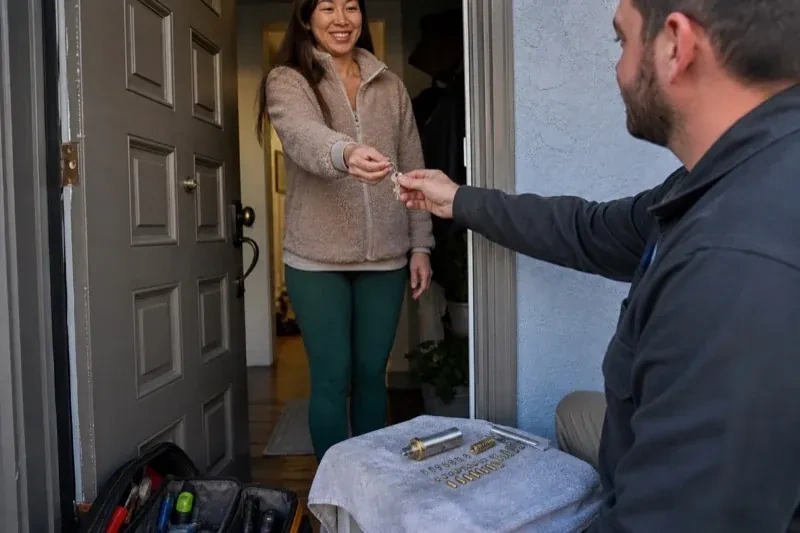
Common keys are cut on the van rather than ordered in, though some restricted systems need the blank from an authorised distributor first. The first key is cut on a code machine, a crisp, original-depth key rather than a copy of a copy, and tried in the first repinned cylinder before another is touched, so any adjustment happens once. The rest are cut to the same code, deburred, and tested in turn. Keys cut this way run smoothly from the start and stay accurate through years of copying, because every later duplicate can be made from the code rather than from a worn blade.
A known number of keys, with names on them
You leave with a set of keys whose count you agreed and can name: one each for the adults, one for the neighbour, one in the lockbox. That is the count of authorised keys, not proof against every copy unless the key system also controls its blanks. A small habit keeps it honest: when a key goes to a contractor, a cleaner or a house sitter, note it and get it back, or rekey when the arrangement ends. From today the answer is a figure you wrote down, not a guess about who might still hold something from years ago.
Lost Keys — Same-Visit Rekey
In the van
- Rekeyable-cylinder reset tool
- Key gauge and decoder
- Cylinder retaining-clip and cap tools
- Rekeying pin kit
- Plug follower set
What affects the quote
Same fees day, night or weekend
1The kind of lock each cylinder lives in
Knob, lever, deadbolt, mortise and rim cylinders come out of the door differently and take different care to refit. A mortise cylinder in a century home is more involved than a builder-grade knob.
2Whether the doors can share one key as they are
Cylinders from the same keyway family are pinned alike with no extra parts. A door from a different family needs a compatible cylinder swapped in if you want a single key, and that part is quoted separately.
3Restricted or high-security keyways
Patented and high-security cylinders carry more parts, need dedicated pin kits and issue keys through authorised channels. Rekeying them takes longer and the blanks cost more than common residential ones.
Lost Keys — Same-Visit Rekey: questions
The ring was stolen with my wallet and licence. What changes?
The priority. A stolen wallet gives the holder your address, and the ring gives them the key to it, so the rekey moves to the front of the queue and the locksmith says so when you call. The work itself is the same: every cylinder the key fitted is repinned and new keys are cut. It helps to list the doors on the phone so the right pin kits and blanks are on the van when it arrives.
Is rekeying the same as changing the locks?
They lead to the same result, a door that a different key opens, by different means. Changing the locks puts new hardware on the door. Rekeying keeps the deadbolt and handle you have and changes what is inside the cylinder, commonly the bottom pins on a conventional lock or a reset on a homeowner-rekeyable one, so a new key operates it and the old one turns nothing. For hardware in good condition, rekeying is the natural choice after a lost key because nothing about the door's look or fit changes.
What is a restricted keyway, and is it worth having?
A restricted keyway uses a controlled key profile whose blanks are supplied only through an authorised channel; the credential required, a letter, a registered account, a dealer agreement or a key card, depends on the system. Rekeying such a cylinder is routine work with the right pin kit. For a household that has just lost a key and wants the next one to be truly countable, it is a sensible upgrade for the main doors, and it can be fitted during the same visit.
Lockout Services
Lost Keys — Same-Visit Rekey near you
For a household in Toronto the common requests are a rekey after moving in, a lockout, a deadbolt that grinds, and a lock that finally needs replacing. For a business they are storefront hardware, staff key control and exit devices. Both lists, and a few less common jobs, are laid out here.